Communication Modes
The TCP Streaming Protocol supports communication modes for different C-ITS participant roles and operational requirements. This section covers protocol variants and session type characteristics.
Singleplex vs Multiplex
The TCP Streaming Protocol provides two fundamental variants that determine how TLC identifiers are handled within sessions.
| Aspect | Singleplex (TCPStreaming_Singleplex) | Multiplex (TCPStreaming_Multiplex) |
|---|---|---|
| Characteristics | Single TLC identifier per session; implicit identifier; optimized format; lower overhead | Multiple TLC identifiers per session; explicit identifier in payload; tagged format; efficient multi-entity |
| Payload Datagram | Payload without TLC Identifier (0x04) | Payload with TLC Identifier (0x05) |
| Use Cases | Individual TLCs; single sensors; point-to-point; resource-constrained devices | Central management; broker operations; multi-device monitoring; aggregation points |
| Benefits | Reduced overhead (8 bytes saved); simpler implementation; lower bandwidth; exclusive access | Single connection for multiple entities; reduced connection overhead; simplified management; dynamic TLC handling |
| Validation | N/A (implicit identifier) | Must match session scope; invalid IDs dropped; no error response; logged for diagnostics |
Session Types
The Subject Interface defines three session types, each tailored for specific roles within the C-ITS ecosystem.
Data Flow Architecture
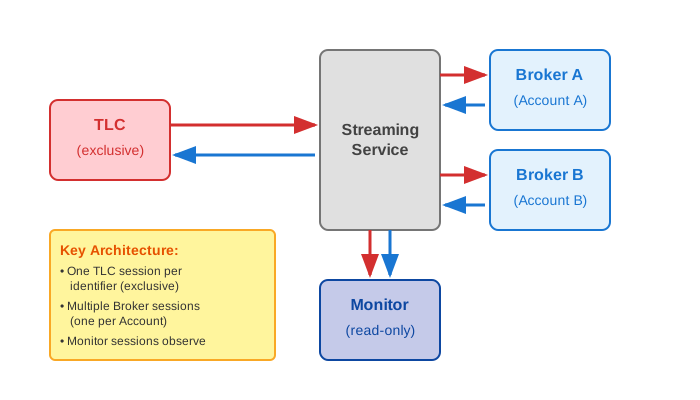
| Aspect | TLC (subject) Sessions | Broker Sessions | Monitor Sessions |
|---|---|---|---|
| Role | Data owner for specific identifier | Data hub for multiple identifiers | System observer for analytics |
| Concurrency | One active session per identifier (exclusive) | Multiple sessions allowed (one per Account) | Multiple sessions allowed (one per Account) |
| Data Flow | Send to all Brokers in scope; receive from all Brokers | Fan-in from TLC (subject); fan-out to TLC (subject) | Receive-only from TLC (subject) and Brokers |
| Protocol Support | Singleplex or Multiplex | Multiplex only | Multiplex only |
| Typical Use Case | Road side systems / devices, Central data publishers | Service Providers, Central C-ITS systems | Analytics dashboard or compliance monitoring |
Security Modes
Security mode is configured when requesting a streaming session through the POST /sessions endpoint. The mode is specified in the session request payload and determines whether the resulting TCP connection uses TLS (Transport Layer Security).
| Aspect | NONE | TLSv1.2 |
|---|---|---|
| Description | Plain TCP communication without encryption | Encrypted communication using TLS v1.2 |
| Use Cases | Development environments; isolated networks; performance-critical applications | Production deployments; public networks; sensitive data transmission; compliance requirements |